Contents
- 01Why job seekers agonize over the ID photo
- 0287.3% of 1,244 job seekers said it “mattered”
- 03Yahoo! Chiebukuro: the real “rejected over a booth photo?”
- 04It’s the quality of the shot, not where it’s taken
- 05Studio ¥10,000 / booth ¥800 / AI ¥200 — how to choose
- 06How to hit studio quality for ¥200
- 078 final checks for a résumé photo
- 08FAQ
In Japan, the résumé ID photo for new-graduate job hunting (shukatsu) carries real weight. When you keep getting cut at the document-screening stage, the worry creeps in: “Is it the photo booth?” “Can the recruiter see through it?” In a Studio Indi survey of 1,244 new-graduate job seekers, 87.3% answered that it “mattered in their job hunt.”
On the other hand, Yahoo! Chiebukuro has a best answer that says “nobody cares even with a booth photo.” This article sorts out the gap between job seekers’ anxiety and the reality on the ground, then explains the 8 checks that work in document screening and how to hit studio quality for ¥200.
Why job seekers agonize over the ID photo
New-graduate job hunting moves in the order ES (entry sheet) → document screening → interview. When you’re cut at the screening stage again and again, you can’t tell whether it was the content or the photo, and the anxiety piles up.
Photo studios are expensive at ¥3,000–10,000, and when you’re applying to 10–20 companies, reshoots really sting. Station and convenience-store photo booths are cheap at ¥700–1,500, but the worry of “is this really okay?” never quite goes away.
87.3% of 1,244 job seekers said it “mattered”
Here is the breakdown of the survey Studio Indi ran with 1,244 new-graduate job seekers (876 women / 368 men).
| Was very important | 39.5% | Most common answer |
|---|---|---|
| Was important | 47.8% | Next most common |
| Neither | remaining ≈ 13% | A minority |
| Total answering “important” | 87.3% | Very important + important |
The fact that nearly 9 in 10 job seekers look back and say “the ID photo mattered” backs up their willingness to invest in it, while also hinting at how large a share carry excessive anxiety. You need to separate “an investment you genuinely need” from “an investment driven by anxiety.”
Get the photo quality 87.3% call “important” — for ¥200
Without paying a photo studio’s ¥3,000–¥10,000, an AI tool that fixes your face position, margins and background gives you a finish that holds up in document screening. At application time, one ¥200 payment lets you reshoot as many times as you like, and your data is saved so you’re free to print more later. You can check the result before you pay, and there’s a refund guarantee if it doesn’t meet the spec.
Make a résumé photo for ¥200Yahoo! Chiebukuro: the real “rejected over a booth photo?”
In November 2022, a question like the following was posted in the job-hunting category. It’s from a job seeker who had kept getting cut at the document-screening stage.
This is about the ID photo you attach to a résumé for job hunting. I often get cut at the document-screening stage. Up to now I’d fixed my hair and shot it in a photo booth around town. Can someone in HR who handles hiring tell at a glance? And on top of that, do they ever write you off as “oh, this was shot in a booth” and cut you in screening, or turn you down?
The words of the response chosen as the best answer to this question (from a self-described 23-grad with job-hunting experience) are striking.
When it comes to the résumé ID photo, nobody cares that you shot it in a photo booth. As for me, I used a photo I’d taken on my phone (white background / suit / no wax) straight on my résumé, and it was no problem. Most likely, the issue is with what’s written on the résumé itself.
Of course it’s one person’s account, and the judgment varies by industry and by the individual recruiter. Still, it’s one example showing a ground-level sense that “a booth photo doesn’t mean instant rejection.” In plenty of cases, the reason you’re cut in document screening isn’t where you took the photo, but the content of the résumé or the quality of the shot.
It’s the quality of the shot, not where it’s taken
What actually tends to get scrutinized on the ground in new-graduate hiring isn’t “where you took it” but the very state captured in the photo. Specifically, the two below are considered the representative points.
Once these two are in order, “where you took it” isn’t the deciding factor. Even a ¥10,000 photo studio drops the impression if things are out of place, and even a ¥200 AI tool makes the difference hard to spot if everything is in order.
Studio ¥10,000 / booth ¥800 / AI ¥200 — how to choose
The options for a Japanese job-hunting ID photo broadly split into three.
| Photo studio (job-hunting plan) | ¥3,000 – ¥10,000 | Going rate for a job-hunting plan. General shoots, e.g. for My Number or a passport, start at ¥1,500 |
|---|---|---|
| Photo booth | ¥700 – ¥1,500 | One-shot, reshoots generally not possible |
| AI ID photo (shot at home) | ¥200 + convenience-store print ¥30 – ¥40 | 0.1mm precision adjustment, free reshoots |
How to hit studio quality for ¥200
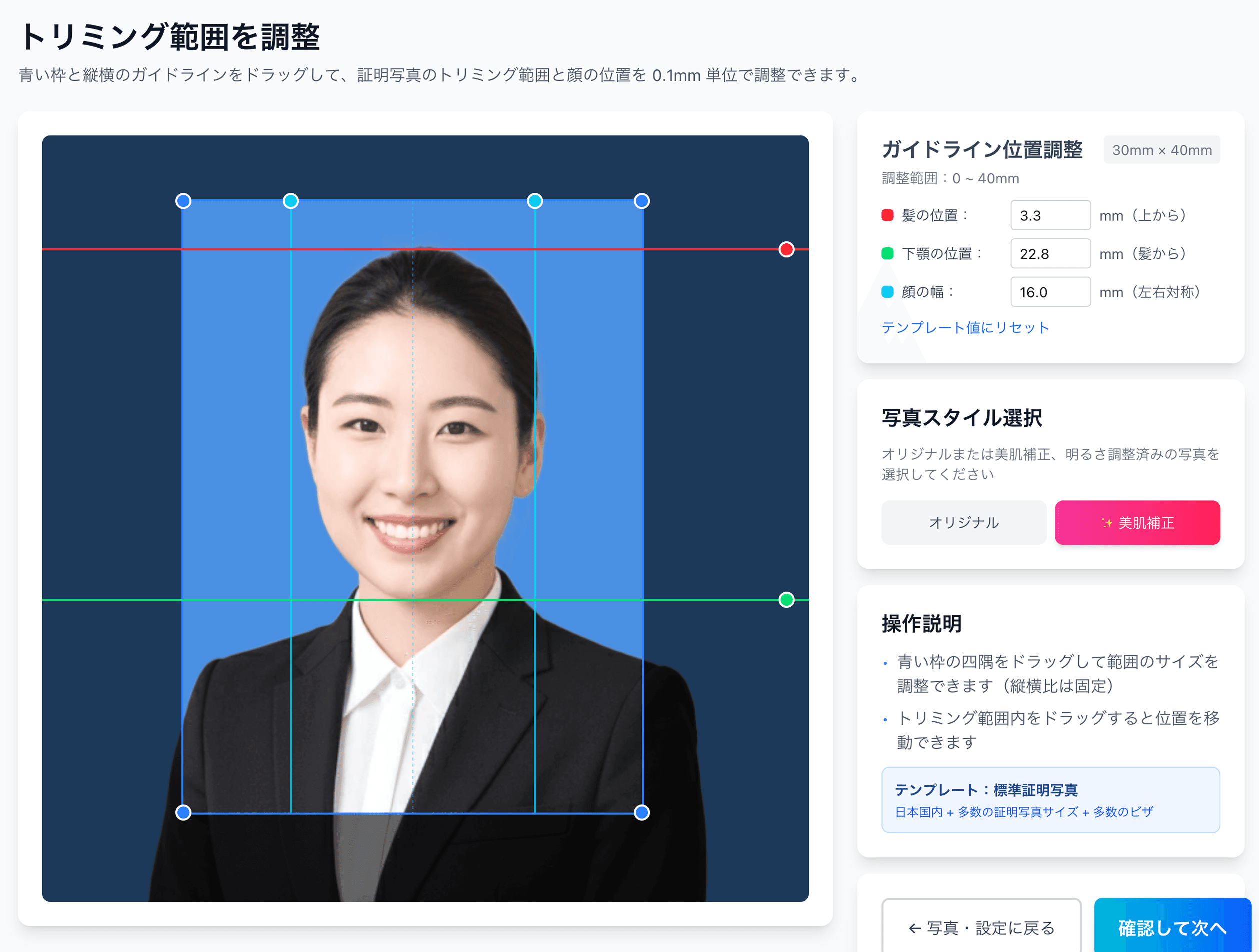
An AI ID photo isn’t simply “cheap.” After shooting, you can fine-tune your face position up, down, left and right in 0.1mm increments, so the kind of precise adjustment you could once only get at a photo studio is completed right on your smartphone.
- 1
Take a front-facing photo at home
Shoot against a white wall, somewhere natural light hits your face evenly. Wear a jacket and a white shirt, fix your hair, keep a neutral expression and your mouth closed. A selfie on a smartphone or DSLR is fine, and having a family member help is fine too — either works.
- 2
Upload at résumé size
From the 105 specs, choose “Résumé 30×40mm.” The AI automatically removes the background and places your face provisionally. From the same original, you can also output for My Number (35×45mm) or a passport.
- 3
Fine-tune the face position in 0.1mm increments
Adjust the margin above the crown of your head and the position of your gaze with the on-screen slider. You can confirm by the numbers whether your collar line is level and whether the center of your face is skewed left or right.
- 4
Pay the ¥200 fee and receive the print sheet
A sheet with cut marks and 4 photos laid out on one L-size sheet is prepared. Since you can reshoot for free as many times as you like, you can keep redoing it until you’re satisfied.
- 5
Print at a convenience store
Just hold the QR code up to a major chain’s multi-copy machine. At ¥30–¥40 for an L-size, you get 4 ID photos. For details, see our convenience-store printing comparison.
The same quality as a ¥10,000 studio, for ¥200 — as many times as you like
Face position, margins, background, exposure ── the AI handles most of what a photo studio does for you. Payment is ¥200, just once, with unlimited reshoots until you’re satisfied. Even at application time, you’re covered with just extra prints.
Make a job-hunting photo for ¥2008 final checks for a résumé photo
Before you attach the printed photo to your résumé, check the following 8 items. If even one applies, reshooting ends up being the faster route in the end.
The common spec for a résumé photo size is 40mm tall × 30mm wide. (It was once listed in the JIS standard, but that was removed in 2020, and the current practice is to follow the sample format the Ministry of Health, Labour and Welfare published in 2021.) Since it’s a different size from a My Number card (35×45mm) or a passport (35×45mm), be careful not to get it wrong when choosing the spec in an AI tool.
Reference links
- All 105 supported specs
- Convenience-store printing compared
- Why most My Number photos fail
- 12 passport rejection patterns
- Photo reprints: the konbini guide
- Pricing details
FAQ
Can a recruiter tell that a photo was taken in a booth?
Is there an expiry date on a résumé ID photo?
Is it okay to smile in the photo?
Does it have to be a suit?
How many résumé ID photos do I need?
Does this work for photos uploaded to OpenES, Mynavi, and similar web platforms?
20 applications, still just ¥30 a convenience-store print — a job-hunting route at 1/30 of a photo studio
Settle it with one ¥200 payment, then reprint at an L-size convenience-store ¥30–¥40 whenever you need to. The more companies you apply to, the lower the per-photo cost — a sensible option made for job seekers.
Create one easily right nowFacts in this article are verified against primary official sources before publication.